
After a fire, the insurer asks for a list of everything you owned. Nobody can write that from memory.
Rebuild reads the photos already on your phone and writes the list for you — every belonging found, named, put in a room and priced.
You have probably been asked for it already, and found what everyone finds: the list is the hardest part of losing everything, and what is not on it is not paid for. But most of us carry years of photos taken inside our own homes. Birthdays, the dog on the sofa, the kitchen halfway through a renovation. The belongings are in the background of all of them, and Rebuild turns forty pictures of one sofa into a single priced line.
Free for the first 100 photos · No credit card · Sign up with Google or an email address in about a minute
Create an account
About a minute, with Google or an email address. No card is asked for now, and none on the free plan later.
Drop in your photos and walk away
The free plan reads the first 100. The scan runs on the server, so close the tab and come back to a first draft of the list.
Pay only when the adjuster asks
One payment unlocks the files they need, and nothing you built is lost while you wait. If you already know you will need them, the Home plan has them from the first photo.
- 1 in 3
- photos in a typical camera roll was taken inside the home, and every one of those is evidence
- 57%
- of total-loss survivors were required to list every item
- 51%
- said itemizing the contents was the hardest part of the claim
- 200+
- belongings listed and priced from an ordinary phone's photos, in under ten minutes
Everything in the first photograph is gone. The list is still in it.
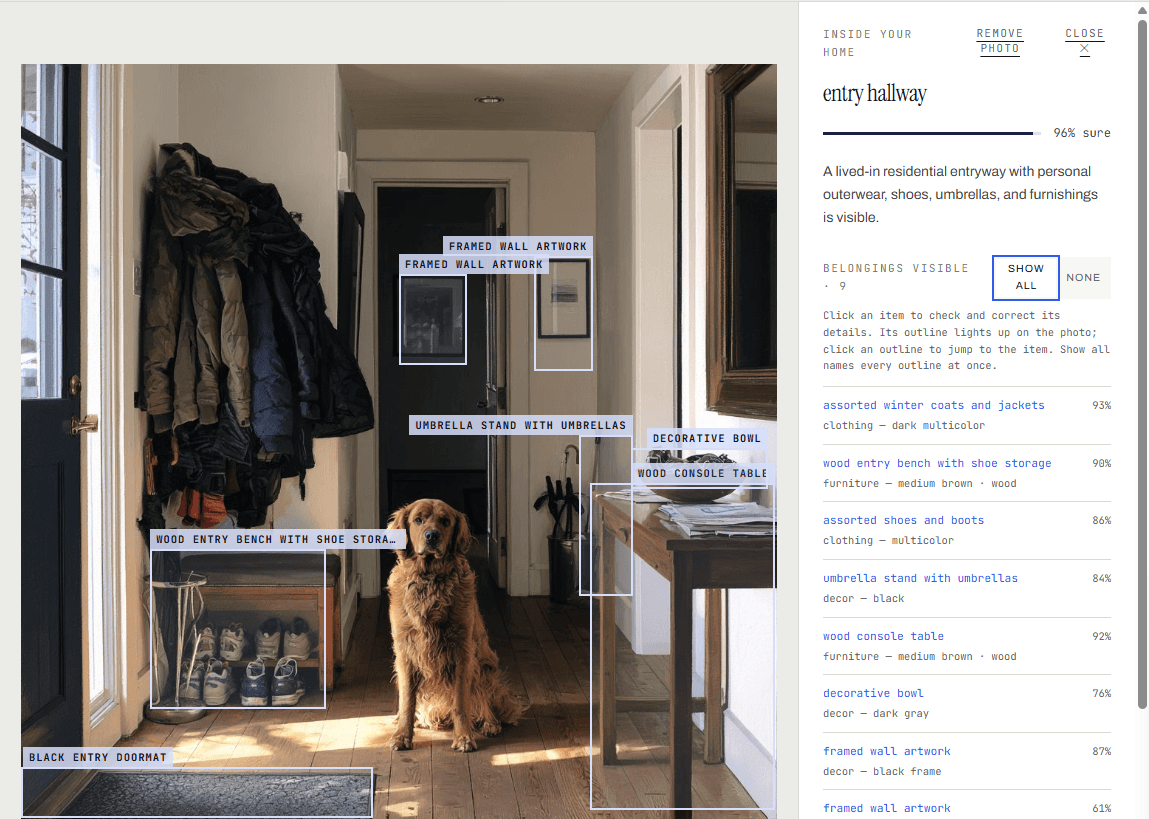
Nobody took the photograph on the left to document a coat rack. They took it because the dog was sitting in the light. But the coats are in it, and the bench, and the shoes under the bench, and the umbrella stand, and the console table, and the bowl on it, and the art on the wall, and the mat by the door.
After the fire there is nothing in that hallway left to count, and the claim still asks for every item that was in it, one line each, with what it would cost to replace. That list cannot be written from the room any more. It can still be read out of the photograph — which is the whole of what Rebuild does.
- 01 The photograph you already have
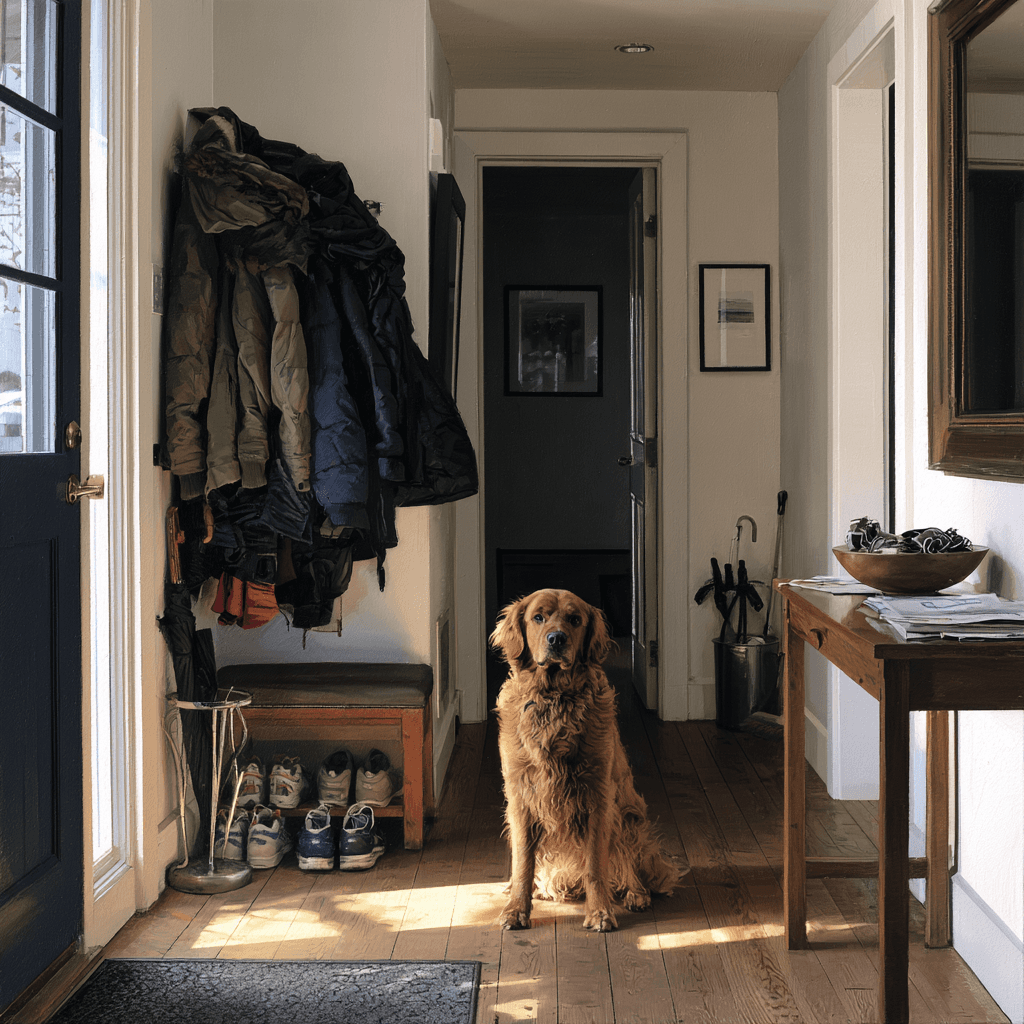
An entry hallway on a winter afternoon, photographed because of the dog. Nine belongings are in the frame behind him. - 02 The same room afterwards
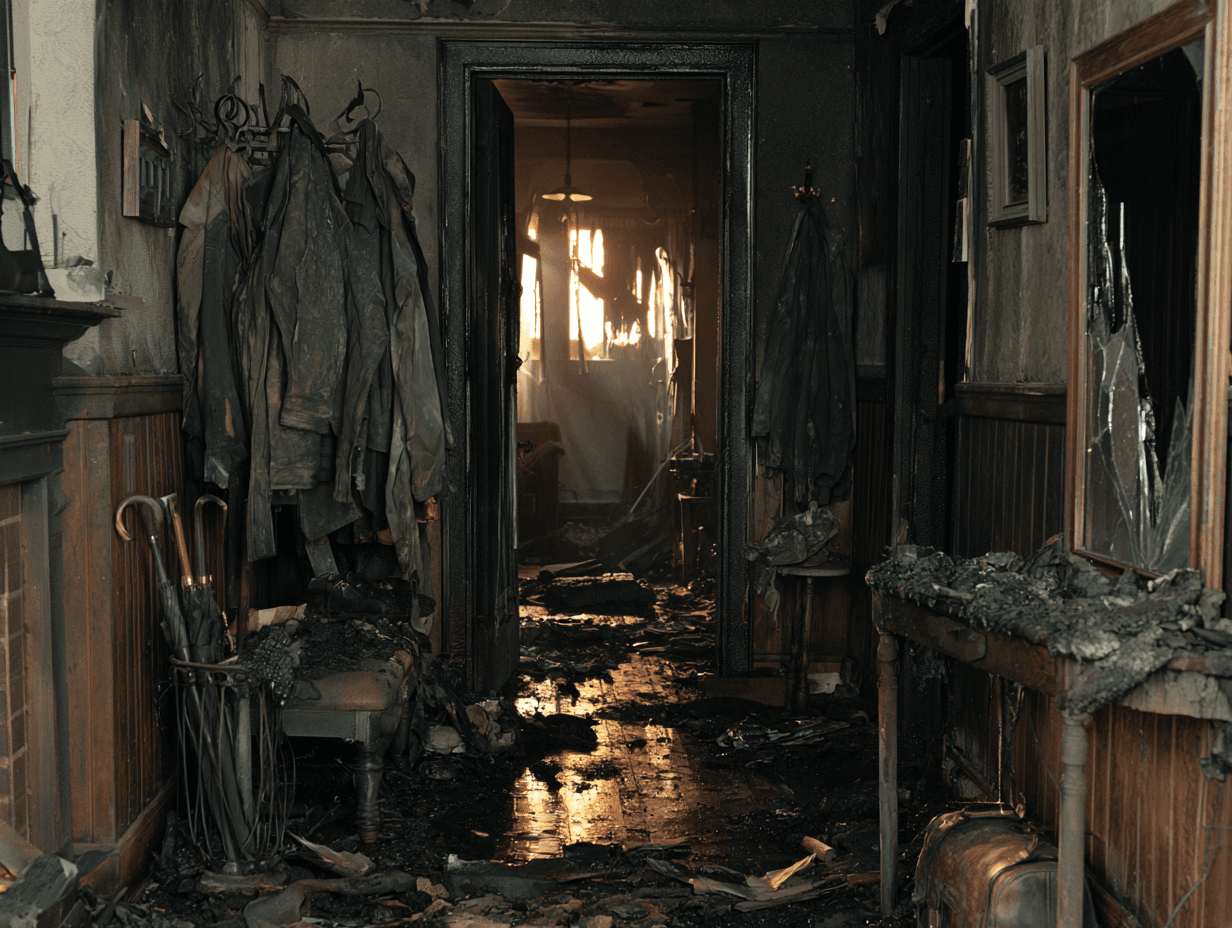
Nothing here can be counted now. The adjuster will still ask for all of it, one line at a time, with a replacement cost beside each one.
Nobody can list a whole house from memory.
- The adjuster asked for every item you owned, one per line, with what it would cost to replace today.
- You opened the spreadsheet, got to forty things, and could not think of a forty-first.
- You keep remembering something else at two in the morning — the good knives, the winter coats, your grandmother's quilt.
- You are being asked to do this from a hotel room, a rental, or someone's spare bedroom.
- Somebody has told you that whatever is not on the list does not get paid for, and they were right.
You do not have to remember it. It is already in your photos.
Years of birthdays, pets on the sofa, the kitchen halfway through a renovation. You were photographing the people; the camera photographed the belongings behind them. Rebuild reads those photos, finds what was in the room, and writes the line the claim asks for — with the photograph attached to it as evidence.
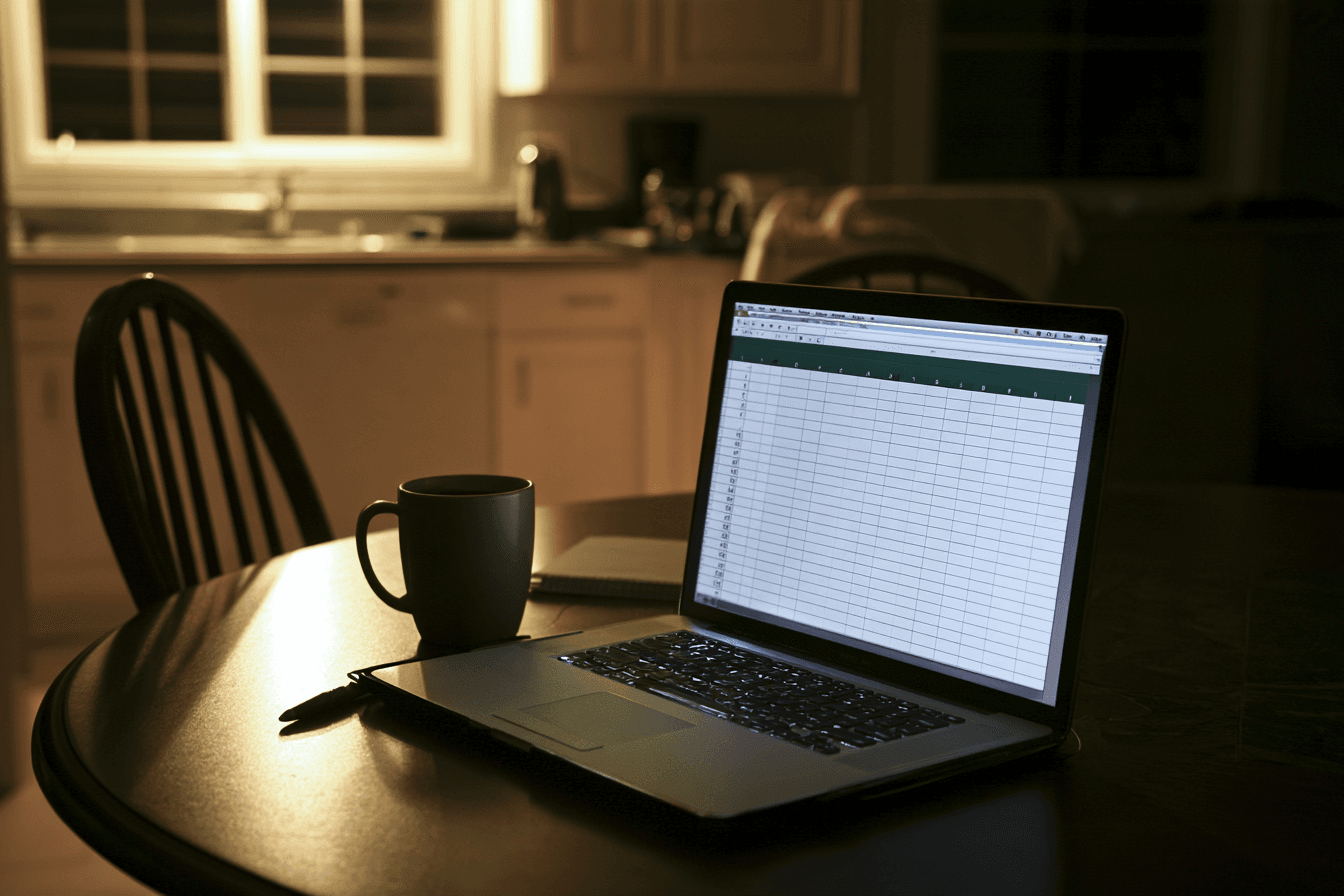
Every item, one line each, with a value.
A contents claim after a total loss is a spreadsheet. It is a hard thing to be asked for a few weeks after the fire, and it is also the document that decides what you are paid. The adjuster wants each belonging on its own line: what it was, roughly when you bought it, what it would cost to replace, and which room it was in. In United Policyholders’ surveys of people who lost their homes, 57% said they were required to list every item, and 51% said itemizing the contents was the hardest part of the whole claim.
Some states have softened this. From 2026 California pays 60% of the contents limit without an itemized list. Washington has no such rule, and most carriers everywhere still want the list before they pay anything beyond an advance.
Rebuild produces the list in the three shapes carriers read: a printed schedule of personal property with the photographs appended, a read-only web copy an adjuster can open without an account, and an Excel workbook for the adjuster’s own software.
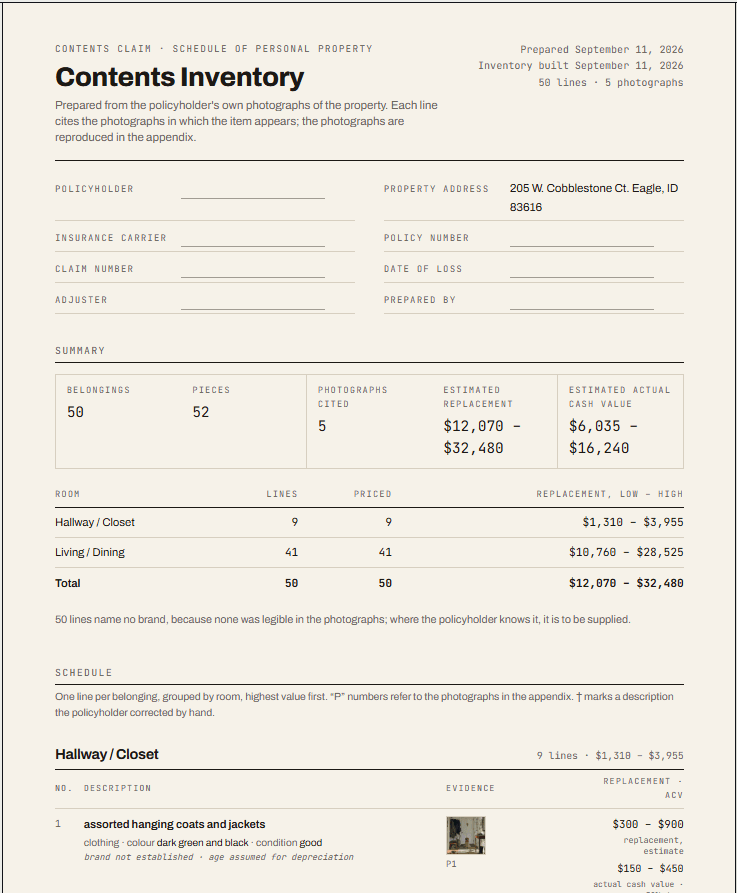
Six steps. The page tells you which one you are on.
You drop in an export from your phone. The scan keeps the photos taken inside your home and lists what it sees. The build collapses one sofa spotted in forty photos into one line. Pricing puts a replacement estimate next to it. You fix what it got wrong and add what the camera missed. Then you hand it over in the three shapes insurers read.
- Add your photos
- Scan them
- Build the inventory
- Price it
- Review the list
- Hand over your claim
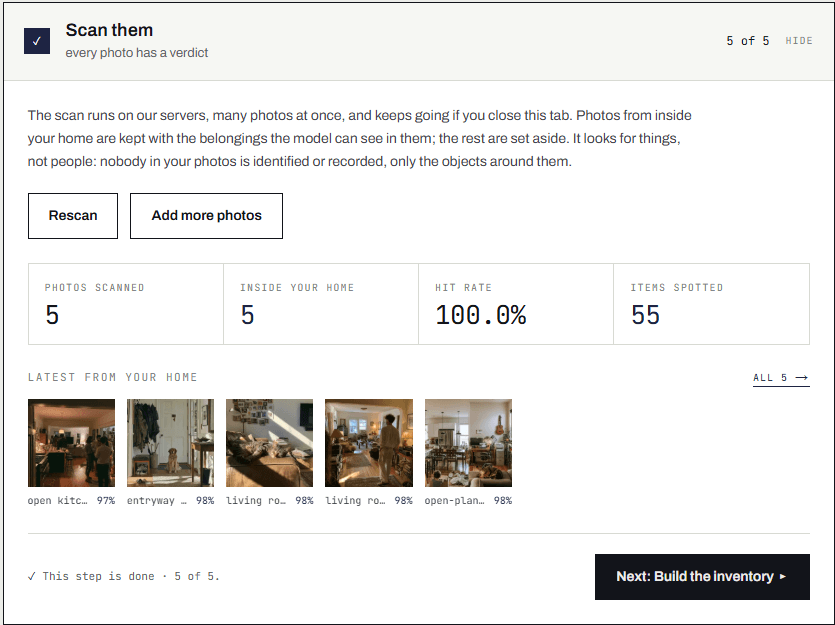
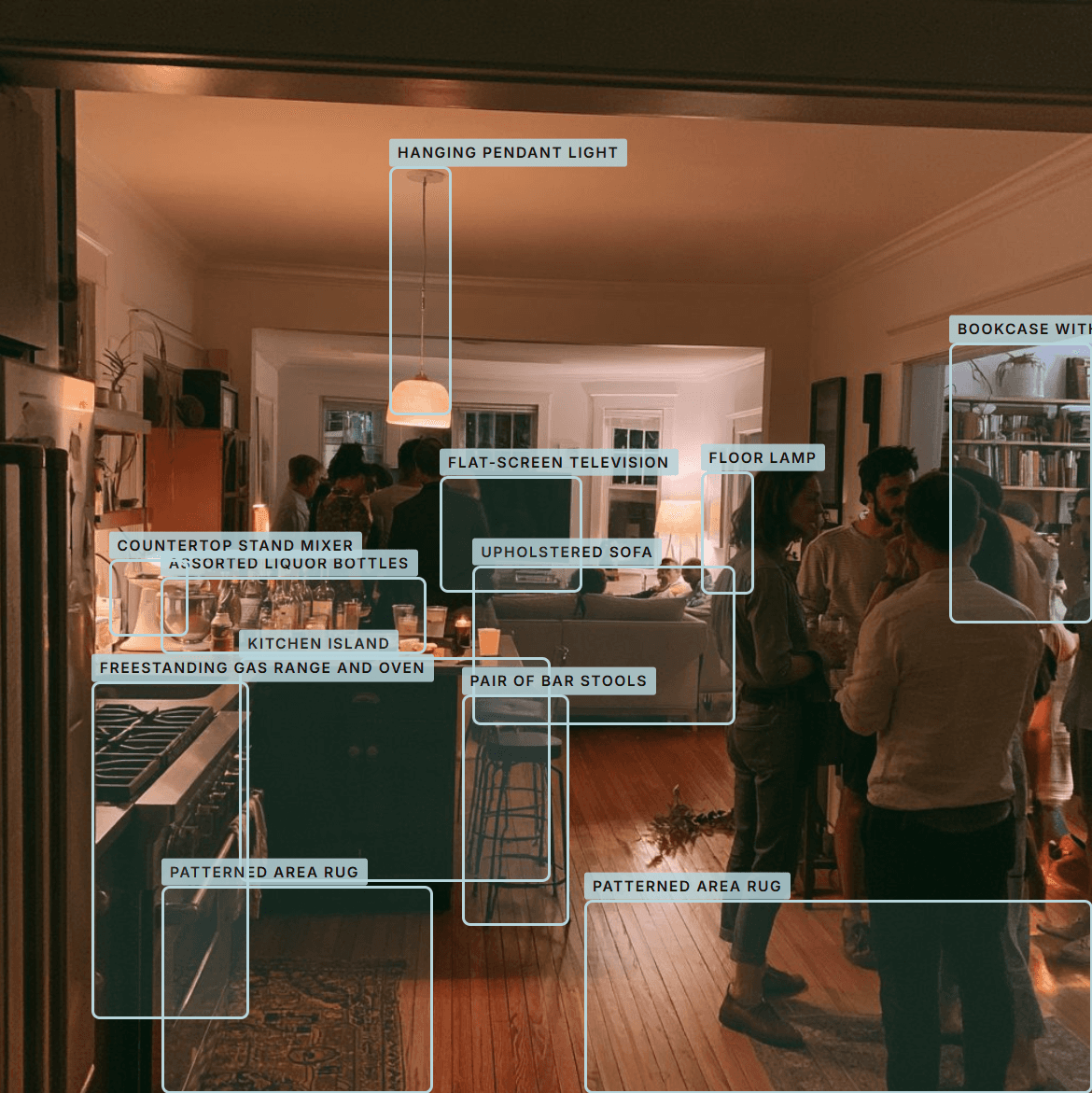
Three ordinary photos, as the scan reads them.
These are photos like the ones on your phone: a pet, a friend in a doorway, the kitchen on a normal day. Each outline is one belonging the model found, and each becomes a line in the inventory, with this photo attached as evidence. The same sofa in forty photos becomes one line, not forty.
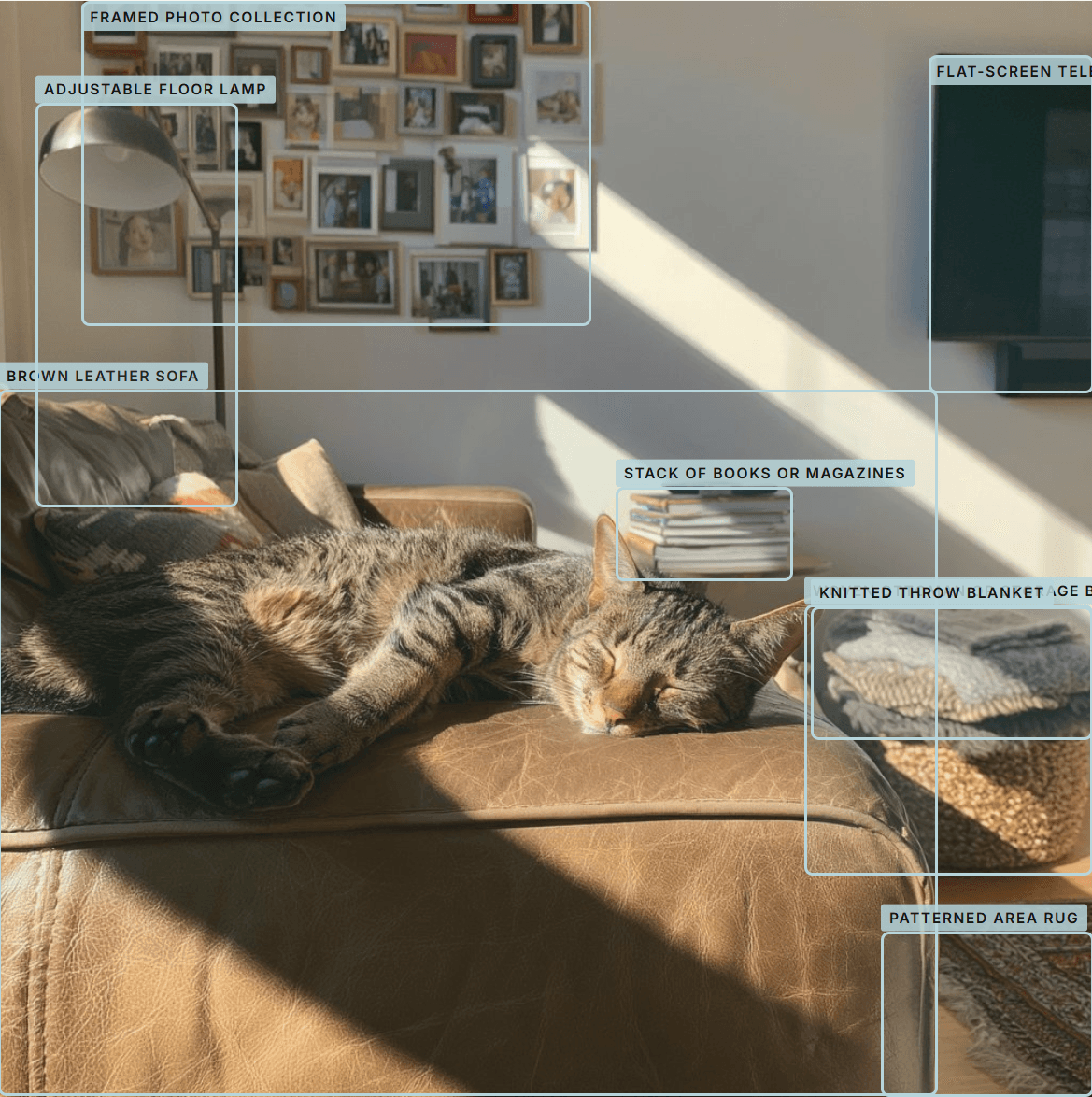
The cat on the sofa. Behind it: the sofa, a floor lamp, the television, a wall of framed photos, a stack of books, a knitted throw, a basket, the rug. Eight lines from one photo. 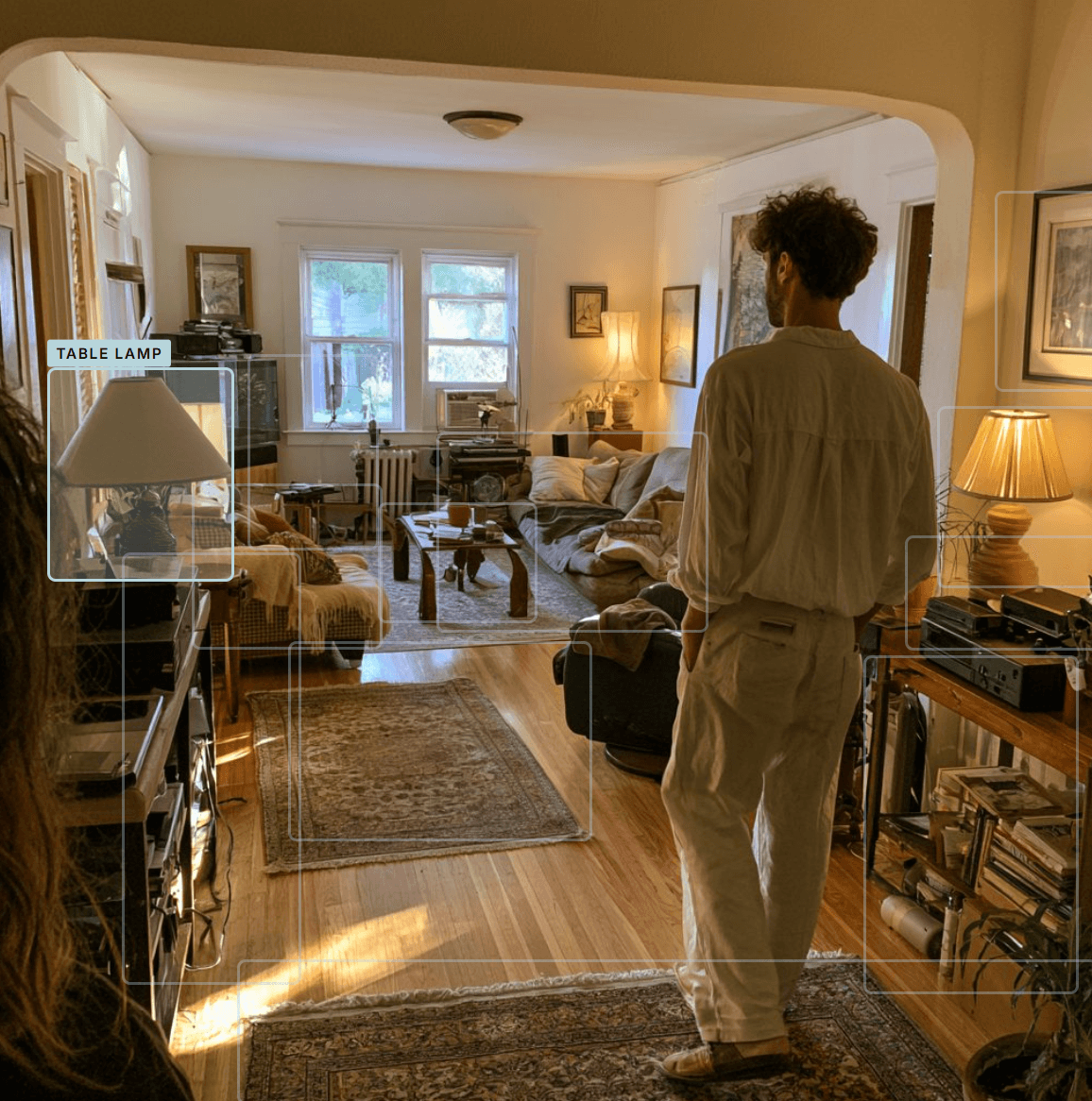
A living room on a sunny afternoon, photographed past a friend. Two lamps, the sofas, the coffee table, the rugs, the stereo and the shelves, each outlined. 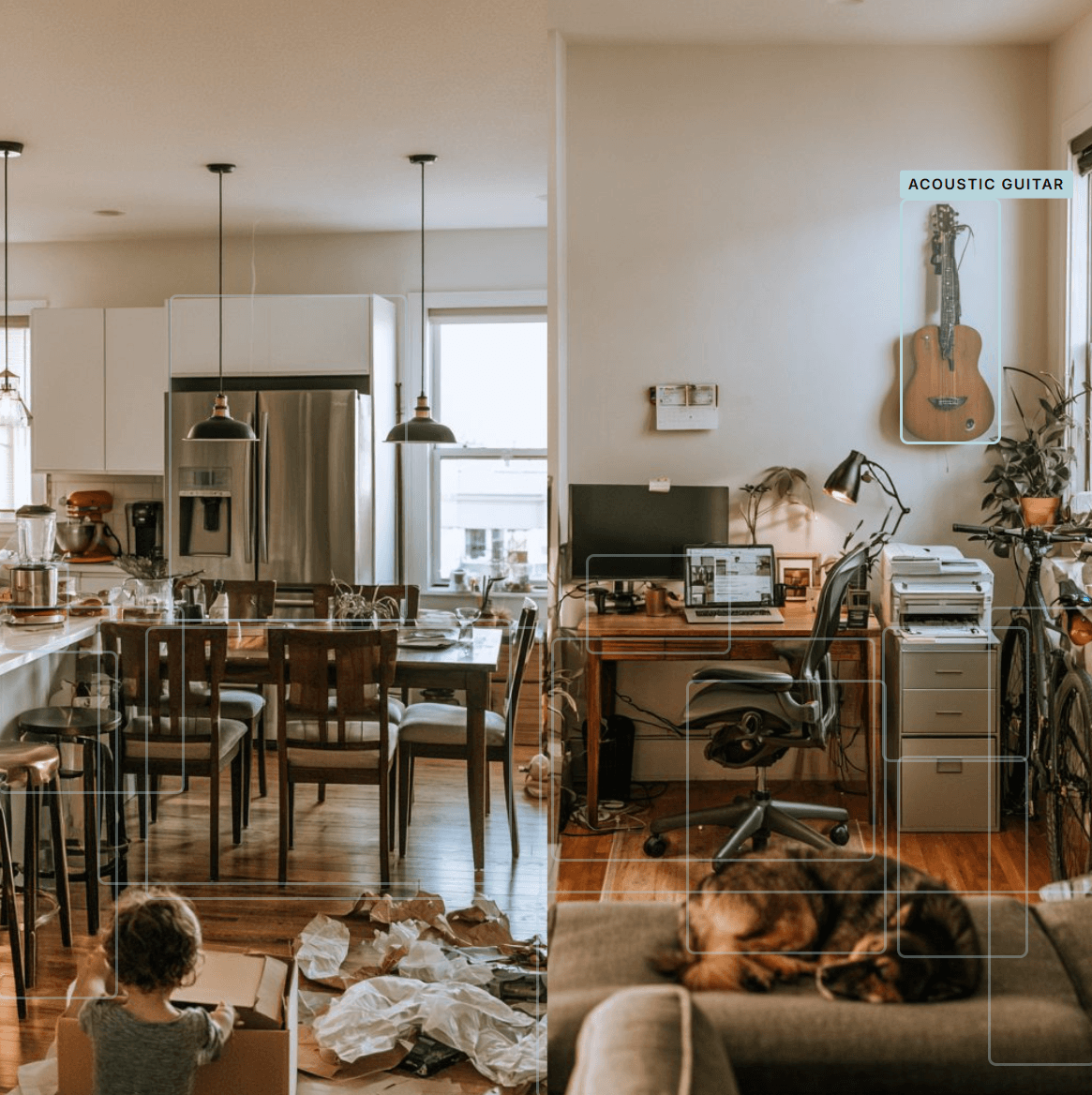
A kitchen and a home office in one frame: the fridge, the table and chairs, the desk and monitor, the printer, the filing cabinet, the guitar on the wall, the bike.
Because the list is the hardest part of losing everything.
In United Policyholders’ surveys of people who lost their homes, 51% said itemizing the contents was the hardest part of the whole claim, and 69% found out afterwards that they were underinsured. The contents list is where settlements are left on the table: what is not on it is not paid for.
What survivors are handed is a blank spreadsheet and their memory, weeks after the fire, while living somewhere else and dealing with everything else. Nobody can list a home from memory, and nobody should have to try. But nearly everyone carries years of photographs taken inside it, and the belongings are in the background of almost all of them.
Rebuild exists to turn that camera roll into the list an adjuster accepts, without a subscription, without anyone taking a cut of your settlement, and without the photographs leaving your control. It was built in Spokane after the 2025 and 2026 fires, for the people who came home to nothing. We charge for the model’s work and nothing else, and we would rather you filed a full claim on the free plan than a thin one on a paid one.
- Your photos stay yours.
The export is opened on your own computer. Three small copies of each photo travel; the originals never do.
- Estimates are honest.
A value is a model’s estimate and is labelled as one. Where it cannot tell, the cell is left blank rather than guessed.
- One payment, one home.
No subscription, no metering, nobody taking a share of your settlement. The price covers the model’s work and stops there, and you only pay it when the adjuster needs the files.
- Built for the person, not the carrier.
The files come out in the shapes adjusters read, but the list is yours, kept as long as you want it, and deleted the moment you say so.
Free to start, with no card. One payment, only when you need the files.
On the free plan you scan, build, price and review the inventory on screen for your first 100 photos. No card is asked for, nothing expires, and you can see exactly what your photos hold before you decide anything at all.
What the free plan holds back is the filing tools — the printed schedule, the Excel workbook, share links, receipt reading and the room walk-through — because two of those cost model time every time they run, and the exports are the thing a claim actually needs. You buy them the day the adjuster asks, not before. Paying unlocks the same household as it stands; nothing is uploaded again.
After that the price depends on one thing: how many photos the plan reads. A phone holds a few thousand, so most homes fit the middle plan. It is one payment, not a subscription, and nobody here takes a share of your settlement.
- Free$0no card, ever
up to 100 photos
- Scan, build, price and review on screen
- HomeRecommended$99one time
up to 3,000 photos
- Scan, build, price and review on screen
- Adjuster workbook and exports
- Share links
- Receipt reading
- Walk-through parsing
- Whole home$149one time
up to 15,000 photos
- Scan, build, price and review on screen
- Adjuster workbook and exports
- Share links
- Receipt reading
- Walk-through parsing
Prices in US dollars. The price covers the model’s work for that many photos. No subscription, no metering, no percentage of your claim.
The questions people ask us first.
- Is it really free, or is there a card at the end?
- Really free, and there is no card anywhere in it. The first 100 photos are read on the free plan, and you scan, build, price and review the inventory on screen. Nothing is charged, nothing expires, and no card is asked for. What the free plan holds back is the filing tools — the printed schedule, the Excel workbook, share links, receipt reading and the room walk-through — and you only need those the day the adjuster asks for files.
- What does it cost if I decide to keep going?
- One payment for your household, sized by how many photos the plan reads. It is not a subscription, there is nothing monthly, and nobody here takes a share of your settlement. Paying unlocks the household exactly as it stands — nothing is uploaded again and nothing you already built is lost. The plan page has the numbers.
- What happens to my photos?
- The export never leaves your computer. Your browser opens the zip locally and sends three small copies of each photo — a 512-pixel version for the model, a thumbnail, and a screen-sized view. A 2 GB export becomes about 85 MB on the wire, and the full-resolution originals stay on your machine. Photos the scan decides were not taken inside your home are set aside and used for nothing else. The model is asked about things, never about who is in the picture. Clearing your household deletes all of it, and so does deleting your account.
- Will an adjuster accept a list made this way?
- It is not a list a machine hands in; it is your list, built from your photographs, corrected by you. Every line cites the photos the belonging appears in, which is stronger than the list most people file — one written from memory with nothing behind it. It comes out in the three shapes carriers already read: a printed schedule of personal property with the photographs appended, an Excel workbook their software imports, and a read-only link they open without an account.
- Are the values real?
- They are estimates, labelled as estimates, and given as a replacement range with a depreciated cash value beside it. They are the starting point for the conversation with the adjuster, not an appraisal, and the adjuster will push back on some of them. Link a receipt or your order history and a stated price replaces the estimate. Where the model cannot tell, the cell is left blank rather than guessed, because an invented number is the thing an adjuster catches and then uses against the rest of your claim.
- What if I do not have many photos of the inside of my house?
- Most people have far more than they think — about one in three photos in an ordinary camera roll was taken indoors. Family and friends can add theirs from a link you send, with no account needed and with you approving every photo. And whatever the camera never saw — the closets, the drawers, the garage shelves — you describe in the room walk-through, and it goes on the list as yours, marked as added without a photo. The free 100 photos will tell you the answer in about ten minutes, at no cost.
- I do not have the energy for another app right now.
- Then do the smallest version: make the account, drop in the photos, and close the tab. The scan runs on the server without you. Come back tonight, or next week, to a first draft of the list. Nothing you build is lost if you step away, and there is no deadline here of any kind.
- Who is behind this?
- Rebuild is made by NovaTrak, and it was built in Spokane after the 2025 and 2026 fires for the people who came home to nothing. We make the contents list and nothing else: we do not negotiate claims and we do not give insurance or legal advice. If the price is what stands in the way, write to info@novatrak.com and say you lost your home. We would rather hear from you than have the claim stall.
Try it on your own photos. Decide afterwards.
The first 100 photos are free, there is no card, and nothing you build is lost if you step away for a week. See what your camera roll actually holds, and if it is worth going further, pick a plan then. If it is not, nothing was charged.
Free for the first 100 photos · No credit card · Sign up with Google or an email address in about a minute · Paid plans are one payment, never a subscription
The Home plan is one payment of $99, it unlocks the household exactly as it stands, and nobody here takes a share of your settlement.